
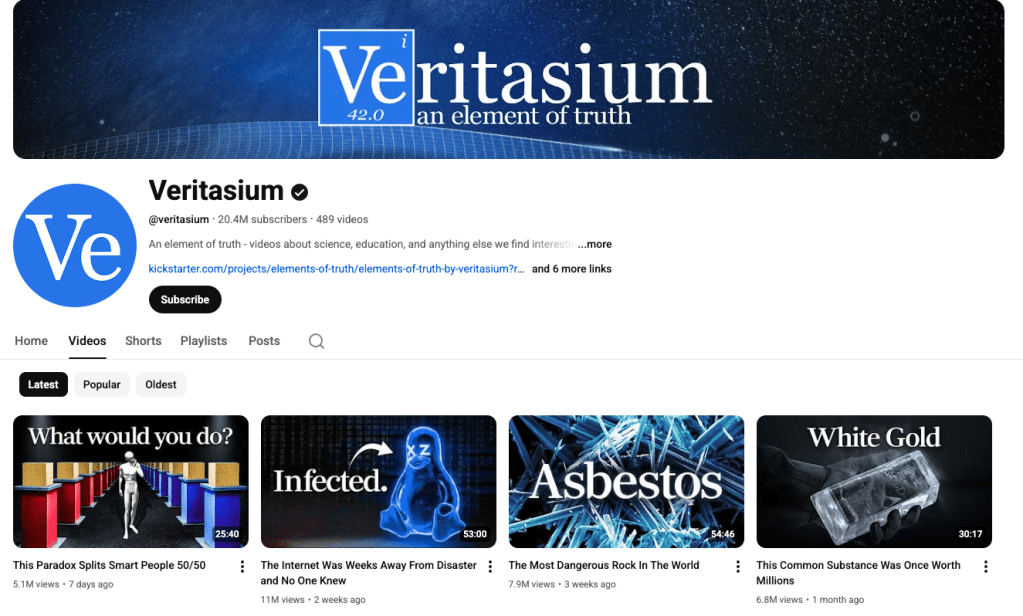
Veritasium is a highly popular science communication in YouTube channel that has 20.4 million subscribers and nearly 4 billion total views across hundreds of videos as of the writing. The channel was founded and is hosted by Derek Muller, a Canadian-Australian who is a scientist, filmmaker, and educator. He holds degrees in physics and education research, which he has leveraged to create a channel, that not only informs but also encourages curiosity and skepticism. The name “Veritasium” comes from the Latin word “veritas,” meaning “truth,” combined with the suffix “-ium,” which is commonly found in element names, symbolizing “element of truth.”
The channel focuses on science education and critical thinking, often exploring topics such as:
- Physics, astronomy, chemistry, biology, and mathematics concepts
- Scientific experiments and demonstrations
- Misconceptions and counterintuitive phenomena
- Interviews and interactions with the public
- In-depth storytelling about scientific discoveries and technologies
Veritasium is known for its high-quality videos that make complex science easy to understand and exciting. It is popular because it provides:
- Clear explanations of difficult scientific ideas, making them easier to grasp
- Engaging experiments and demonstrations that help visualize concepts
- Segments where the host interacts with the public, testing common beliefs or asking people to guess outcomes
- Production quality that is as good as traditional educational media.
10 Popular Veritasium Videos
1. Why Are 96,000,000 Black Balls on this Reservoir?
Explains why millions of black “shade balls” are used on a reservoir to reduce chemical reactions, heat, and evaporation.
2. These are the asteroids to worry about
Explore the challenges of asteroid detection and the potential consequences of impact. The video examines the formation of asteroids and their varying compositions. Experts discuss detection difficulties and potential mitigation strategies.
The video demonstrates their incredible thermal insulation properties with a surprising experiment. Learn the history of aerogel creation and its diverse applications, from Mars rovers to comet sample return missions.
4. Backspin Basketball Flies Off Dam
This video explores the Magnus effect by examining why a basketball thrown with backspin flies significantly further than one dropped normally from the Gordon Dam
5. Why It Was Almost Impossible to Make the Blue LED
This video explains how blue LEDs were made, a significant technological achievement that seemed almost impossible for years. While red and green LEDs were developed in the 1960s, a blue LED was crucial for mixing all three colors to produce white light, transforming global lighting.
6. The Simplest Math Problem No One Can Solve – Collatz Conjecture
Explore the famous Collatz Conjecture, a simple math problem. The video uses visual aids to show number sequences and their patterns. See how this basic idea leads to complex math challenges.
7. The Man Who Accidentally Killed The Most People In History
The video discusses a scientist named Clair Patterson, who unintentionally created three inventions that led to the deaths of millions of people, including himself.
8. Inside The Navy’s Indoor Ocean
This video shows the Naval Surface Warfare Center in Carderock, Maryland, home to the largest indoor ocean basin. The facility simulates different ocean conditions, enabling engineers to test models of Navy ships and enhance their designs before full-scale construction.
9. I Waterproofed Myself With Aerogel!
Aerogel has great properties, but it can be hard to handle. This video looks at how to modify aerogels to use their unique features and enhance their extraordinary properties.
The video shows a nearly perfect sphere made of Silicon that scientists created as one of the roundest objects ever made. If it were the size of the Earth, any bumps on its surface would only be a few meters tall.
📌 Note: Titles and exact video ranking vary over time.
The channel encourages discussions among scientists, educators, students, and curious minds. Topics include physics, engineering, psychology, mathematics, and technology. By mixing storytelling with solid science, Veritasium makes learning exciting and approachable.
If you enjoy fascinating scientific ideas and experiments, check out Veritasium on YouTube: https://www.youtube.com/@veritasium. You might become more curious about the universe!
 Open Access Learning PH
I love science, this so informative and interesting.
LikeLike